
Sample chronicle. The family shown here is fictional and for illustration only. This is what the result of your own research looks like.

EuropaRoots

Family Chronicle

Hampel

From Upper Silesia to Milwaukee — and back through the parish registers

Niklasdorf · Neisse · Oberglogau · Milwaukee
1820 — 1881 — today

16 people documented19 primary sources5 Silesian parishes

Family Tree

Four generations at a glance

Reference person · Generation 0

Robert James Hampel

* 1958

Milwaukee

Parents · Generation 1

Edward Hampel

* 1931 · † 2019

Milwaukee

Machinist

Margaret Bauer

* 1934

Milwaukee

Grandparents · Generation 2

William Hampel

* 1902 · † 1971

Milwaukee

Brewery worker

Frieda Konietzko

* 1906 · † 1988

Milwaukee

Anton Bauer

* 1899 · † 1965

Milwaukee

Carpenter

Hedwig Scholz

* 1903 · † 1979

Milwaukee

Great-grandparents · Generation 3 — the emigrant generation

Josef Hampel

* 1855 · † 1921

Niklasdorf

Emigrated 1881

Maria Reimann

* 1858 · † 1929

Neisse

Franz Konietzko

* 1860 · † 1918

Oberglogau

Emigrated 1882

Agnes Wagner

* 1863 · † 1934

Oberglogau

Johann Bauer

* 1857 · † 1925

Leobschütz

Emigrated 1880

Theresia Nowak

* 1861 · † 1930

Leobschütz

Paul Scholz

* 1859 · † 1922

Neisse

Klara Wenzel

* 1864 · † 1938

Neisse

Life Stories

Three lives, told

Robert James Hampel

Reference person

b. 1958, Milwaukee

Robert James Hampel was born on 9 August 1958 in Milwaukee, Wisconsin — the third generation of his family born in the United States. He grew up in a German-Catholic neighbourhood on the city's south side, where his grandfather had worked in the breweries, and he knew only that the family had come from somewhere called Silesia — a place that no longer appears on any modern map of Germany.

He commissioned this chronicle to find what that word actually meant. From his grandparents' generation onward the family is documented in Milwaukee; this research carries the line a full century further back, across the ocean, into the Catholic parishes of the Neisse and Oppeln districts of Upper Silesia, where the Hampel name is recorded in the baptismal registers from the early nineteenth century.

Josef Hampel

Great-grandfather · the emigrant

b. 1855 Niklasdorf, † 1921 Milwaukee

Josef Hampel was baptised on 2 February 1855 in the Catholic parish of Niklasdorf, in the county of Neisse — the entry survives in the parish baptismal register, the primary source on which this whole branch rests. He was the elder of two brothers in a family of small-holders.

In 1881, at twenty-six, Josef boarded a ship for America and settled in Milwaukee, where a Silesian-Catholic community had already formed. His younger brother Paul stayed behind on the family land in Niklasdorf. For more than sixty years the two branches grew apart on opposite sides of the ocean — but the same parish register that recorded Josef's baptism also recorded Paul's children.

Paul's branch was expelled from Silesia in the winter of 1945, when the region passed to Poland and its German population was forced west. This chronicle follows the parish register to the documentary horizon and marks honestly where Paul's line goes cold — the point at which only the family's own letters and papers could carry it further.

Maria Reimann

Great-grandmother

b. 1858 Neisse, † 1929 Milwaukee

Maria Reimann was born in 1858 in the town of Neisse, the seat of one of the oldest church districts in Upper Silesia. The Reimann line is the most deeply documented in this chronicle: the Neisse parish registers reach back, without a gap, to a marriage recorded in 1820 — five generations before Maria herself.

She married Josef Hampel in Neisse in 1880, the year before they emigrated; the marriage entry names both sets of parents and so ties the Hampel and Reimann lines together with a single primary source. In Milwaukee she raised seven children and kept the family's Silesian German alive at home until her death in 1929.

Source Gallery

Every finding — honestly graded

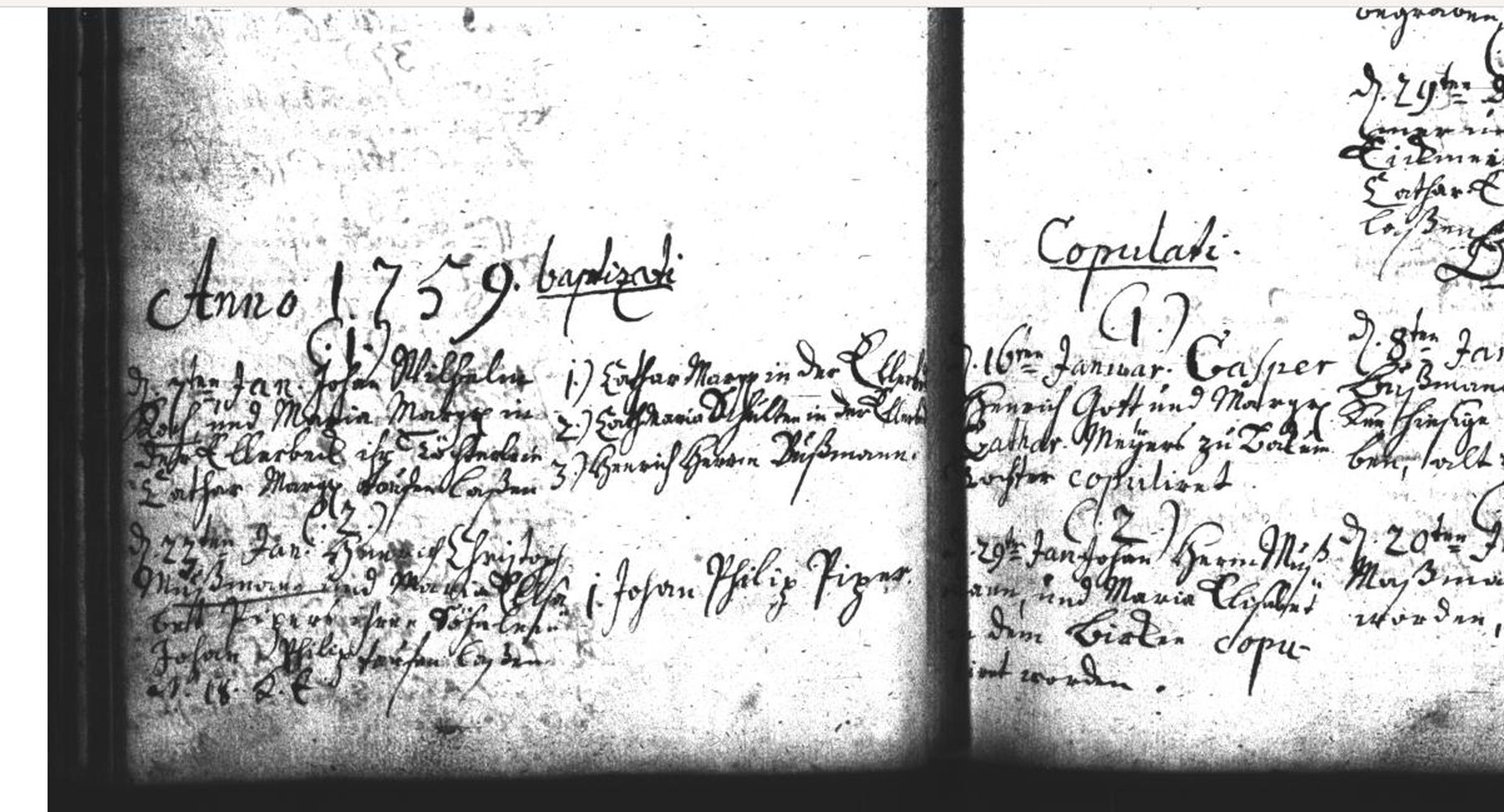
A selection of the sources behind this chronicle. Each finding is graded by how strong the evidence is — a primary source (a parish or civil register), a secondary index, or transparently marked as unconfirmed. So you can see at a glance what every statement rests on. In your own chronicle the original images are linked — as a picture where the source permits it, otherwise as a permalink.

Primary source Secondary index Unconfirmed
  • Baptismal register, Catholic parish of Niklasdorf

    Primary source

    Baptism of Josef Hampel, 2 February 1855

    Vol. III, fol. 71 · Diocesan Archive, Neisse district

  • Marriage register, parish of Neisse

    Primary source

    Marriage of Josef Hampel × Maria Reimann, 1880

    Vol. VII, fol. 204 · Diocesan Archive, Neisse district

  • Baptismal register, parish of Oberglogau

    Primary source

    Baptism of Franz Konietzko, 1860

    Vol. V, fol. 188 · Parish archive, Oberglogau

  • Marriage register, parish of Neisse — Reimann line

    Primary source

    Marriage of 1820, the deepest documented entry of this chronicle

    Vol. I, fol. 12 · Diocesan Archive, Neisse district

  • Silesian local-heritage book (Ortsfamilienbuch), Leobschütz

    Secondary index

    Index entry for the Bauer line — a pointer to the parish entry, not the original record itself

    Entry 2188 · Secondary index

  • Paul Hampel's line after 1945

    Unconfirmed

    Inferred from a 1947 resettlement list in West Germany — no parish record yet located to confirm the link

    without permalink · transparently marked

The Research Journey

Two brothers, one ocean, one war

The Hampel family belongs to Catholic Upper Silesia — the church districts of Neisse and Oppeln, where the parish registers were kept without interruption from the early nineteenth century. That is the ground this chronicle stands on: every name in the European generations is anchored in a baptism, marriage or burial entry from those registers.

The crossing itself is the bridge. A US passenger manifest of 1881 and a Milwaukee naturalisation record place Josef Hampel in America and let us connect the Milwaukee family to its Silesian origin — but the deep documentary work is on the European side, in the church books. We name the American records for what they are: the handoff point, not the heart of the research.

And then there is the rupture. The brother who stayed, Paul, lived through the region becoming Polish in 1945 and the expulsion of its German population. The parish register holds his children's baptisms up to the war; after that the trail needs the family's own papers. We mark that break honestly rather than paper over it — because a chronicle is only worth as much as the line between what is proven and what is merely hoped.

Left open

What we could not conclusively prove

We mark transparently where a line ends or a finding stays uncertain. No invented data, no filler — you see exactly what is documented and what is not.

  • Paul Hampel's branch after 1945

    Josef Hampel's brother Paul stayed in Niklasdorf; his branch was expelled in 1945. A 1947 resettlement list in West Germany names a Paul Hampel of the right age, but no church record has yet been found to confirm that it is the same man. The link is shown as unconfirmed until a primary source closes it.

  • The Reimann line before 1820

    The Neisse registers carry the Reimann line back to a marriage of 1820. Earlier entries very probably exist in the same parish, but reaching them goes beyond the depth of this tier; it is the natural next step for a deeper commission.

  • A name that drifted at the dock

    The Milwaukee naturalisation papers spell the family name both Hampel and Hample. We treat the parish-register spelling (Hampel) as authoritative and note the American variant, so a descendant searching under either form still finds the line.

Your own chronicle

This is what your family's story looks like — in weeks.

You give us what you know — we research the German, Austrian and Central-European archives and deliver a chronicle like this one, source-backed and told as a story.